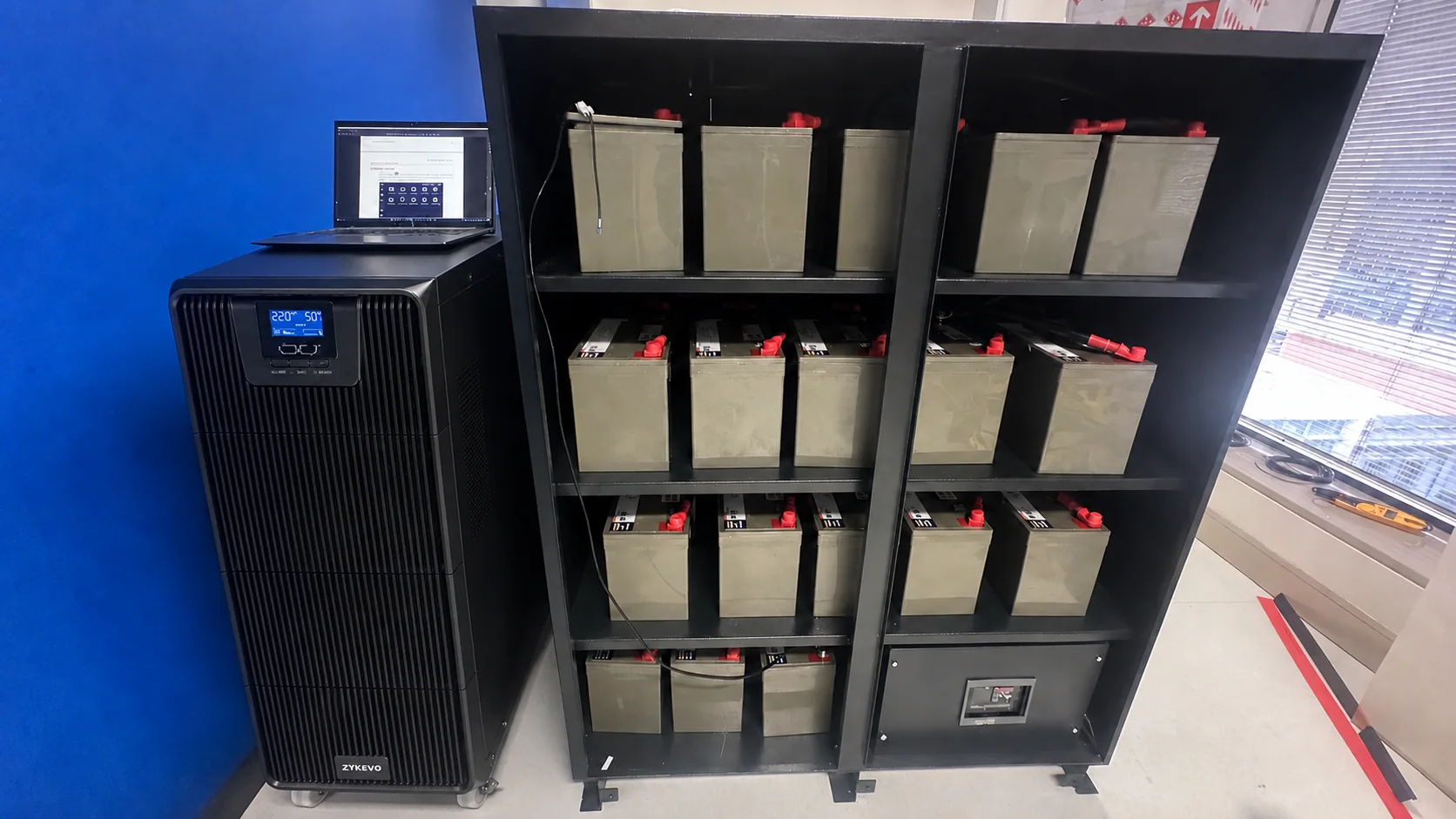
Replacement is a system review, not a date-only decision
UPS battery replacement is often triggered by a maintenance schedule, low runtime, an alarm or visible battery condition. Those signals matter, but battery age alone is not enough to define the correct replacement scope.
The battery bank, UPS charger, DC protection, cabinet, cable route and actual connected load work as one system. Replacing only the batteries without reviewing those parts can leave the site with the same runtime problem, an unresolved charging issue or an undocumented string arrangement.
For regional UPS service companies, IT providers, server-room teams and backup-power solution companies, a structured pre-quotation review helps separate a straightforward like-for-like VRLA replacement from work that needs cabinet, cable, charger, protection or lithium-upgrade assessment.
Start with evidence from the installed UPS and battery bank
Collect evidence before removing or pricing the existing bank. Photographs of the UPS nameplate, battery labels, cabinet, breaker, terminals and cable arrangement are useful. The service team should also record the exact UPS brand and model, topology, rated kVA and kW, event history and available alarm information.
Battery labels and installation records create a starting point, but they do not replace verification of the UPS DC requirement and actual wiring. Where records and the installation disagree, the qualified local service team should resolve that discrepancy before a replacement quantity is confirmed.
- Battery manufacturer and exact model shown on the label.
- Nominal voltage and rated Ah of each installed battery block.
- Installation or previous replacement date, if reliably recorded.
- Battery quantity in series and the number of parallel strings.
- Cabinet or rack arrangement, DC breaker, fuse and cable route.
Check battery condition and site temperature
An older bank may be due for scheduled replacement, but operating history and present condition also matter. High ambient temperature, frequent discharge cycles, poor recharge conditions, loose terminals and imbalance between blocks can reduce usable service life. A newer bank can also underperform when the charger or installation conditions are unsuitable.
Record the normal and observed site temperature, ventilation, dust or moisture exposure and frequency of power interruptions. These facts help explain battery condition and inform the service plan; they are not a substitute for model-specific battery data or a safe inspection by qualified personnel.
- Swelling, deformation, leakage, residue or damaged insulation.
- Corrosion, loose terminals or signs of overheated connections.
- Damaged cabinet shelves, doors, rack components or protection devices.
- Repeated UPS battery alarms or runtime below the operating requirement.
Confirm the UPS DC bus and battery-string arrangement
The UPS power rating does not by itself identify the battery string. Confirm the exact UPS brand and model, topology, rated capacity, nominal DC bus and allowable battery voltage range. Where possible, compare the UPS manual and setting pages with the existing installation.
Record the existing batteries in series and the number of parallel strings. Also confirm the UPS low-battery setting, shutdown behavior, DC breaker and fuse arrangement, cable route, and whether the system uses a center tap or a two-wire full bus. Two UPS systems with a similar kVA label can use different battery quantities and DC voltages.
Review actual load, required runtime and operating objective
The replacement bank should be reviewed against the actual critical load, not simply the UPS maximum nameplate capacity. Measure or document the connected load in kW where possible and note expected load growth. Two sites with the same UPS model can require different battery arrangements because their real loads and operating objectives differ.
Clarify whether the site needs time for an orderly shutdown, bridging to generator start or a longer period of continuous operation. A final runtime requires approved battery data and complete assumptions, including the actual load, end voltage, temperature, UPS losses and battery condition. A general Ah value is not a guaranteed runtime.
Check the UPS charger and recharge requirement
The UPS charger must charge the selected bank within the permitted voltage and current limits. For a like-for-like lead-acid replacement, review normal charging behavior, available charging current, charging voltage and any settings that must be confirmed after the new bank is installed.
Recharge time becomes important where utility outages are frequent. A bank that is discharged repeatedly may not recover as intended if available charge current is limited. The required outage cycle and recovery period should be discussed before a proposed Ah capacity or string count is treated as final.
Inspect the cabinet, terminals, connections and cable scope
A like-for-like battery label does not prove that the mechanical and connection scope is unchanged. Check the external battery cabinet or rack for internal dimensions, ventilation, access, corrosion, shelves, insulation, door condition and service clearance. Confirm terminal orientation, interlink length, cable condition and the route to the UPS.
If the replacement changes the number of strings, battery dimensions, cabinet arrangement or battery technology, the project may require a broader engineering review. Do not assume that an existing cabinet can be reused without checking the selected battery model and local installation conditions.
Choose between like-for-like VRLA replacement and lithium review
A like-for-like VRLA direction can be appropriate when the UPS DC system, charger, cabinet, connections and operating objective remain suitable and the selected replacement model is confirmed. Even then, final battery quantity, terminal arrangement and commissioning scope should be verified rather than copied from an incomplete record.
Lead-acid to lithium may make sense when a project has a defined lifecycle, footprint, maintenance or operating objective that justifies a separate compatibility review. It is not an automatic or plug-and-play upgrade. The review must cover the UPS DC operating window, charging voltage and current, BMS and protection behavior, communication requirement, cabinet layout, local service process and destination requirements.
The existing lead-acid string is useful evidence, but it is not a direct lithium design. A CAN or RS485 connector alone does not prove protocol compatibility, and no high-voltage lithium battery should be selected from UPS kVA alone.
Plan the replacement and commissioning boundaries
A responsible replacement plan identifies the parties and boundaries before the outage window is scheduled. It may cover isolation planning, safe removal, installation sequence, polarity checks, connection and torque checks, UPS settings review, functional checks and handover documentation.
Record who is responsible for local electrical work, removal and disposal, commissioning, code compliance and ongoing maintenance. ZYKEVO can support product selection, configuration discussion, documentation and China-side supply coordination for suitable projects, but it does not replace qualified local site responsibility.
Information to include in a battery replacement RFQ
A useful RFQ combines electrical evidence, the existing battery arrangement, operating duty, site condition and commercial scope. Final model, battery quantity, runtime, documentation, availability and commercial terms must be confirmed in writing for the actual project.
- UPS brand, exact model, topology, rated kVA and rated kW.
- Actual connected load in kW and the required backup objective or time.
- Existing battery type, model, voltage, Ah and total quantity.
- Batteries per series string and number of parallel strings.
- UPS DC bus or operating range, charger voltage and available current.
- Cabinet photographs, internal dimensions, terminals, breakers and cable information.
- Site temperature, ventilation, maintenance access and destination country.
- Preferred like-for-like VRLA replacement or a separate lithium-upgrade review.
- Required documents, labels, packaging or OEM presentation scope.
Project limitations
Battery replacement does not repair an existing UPS charger, inverter, control fault or site wiring issue. Safe isolation, testing, installation and commissioning remain the responsibility of the qualified local service team.
This guide does not confirm a universal battery model, compatibility, fixed service life or guaranteed runtime. Certification and shipping documentation are confirmed according to the selected model and destination. Project-specific evidence is required before quotation and final selection.
Related project paths
- Plan a UPS battery replacement project
- Review UPS batteries and external battery cabinets
- Use the UPS Battery Replacement Checklist
- Prepare the wider UPS project requirement checklist
- Review a lead-acid to lithium upgrade separately
- Review high-voltage lithium only for a confirmed upgrade scope
- Send a UPS battery replacement requirement